Choosing Home Gym Equipment is less about building a showroom and more about making regular training possible. Strength coach and author Mark Rippetoe puts the goal plainly: “Strong people are harder to kill than weak people, and more useful in general.” His point is strength, not shopping. Still, it offers a useful test: will this equipment help you train safely and consistently?
Start with your space, budget, and the workouts you actually enjoy. Measure the room, including ceiling height, doorways, and clearance around moving parts. Small room? Measure it. A folding bench may fit where a full rack cannot. A pair of adjustable dumbbells can cover many exercises, while a barbell setup may suit progressive strength training better. Neither choice is automatically right.
Before buying, check the equipment’s weight limits, adjustment range, stability, warranty, and replacement-part availability. Read independent reviews, but compare the details with your own needs; a popular machine can still be awkward in a narrow room. Consider flooring, noise, delivery, and assembly, too. Those costs are easy to overlook. I’ve seen the “perfect” setup become a coat rack when it demanded too much space or effort. That is not a scientific rule, just a useful reminder.
This guide will compare common equipment types, explain trade-offs, and help you build a practical setup in stages. Begin with a few reliable essentials. Add pieces only when your training shows a real gap. You do not need a complete gym on day one.
Define Training Goals Around ACSM’s Recommendation for 2 Strength Days per Week
Choosing home gym equipment starts with a clear, repeatable goal. The American College of Sports Medicine recommends strengthening all major muscle groups at least two days per week. That gives your equipment a job: help you train your legs, hips, back, abdomen, chest, shoulders, and arms consistently. If your goal is general strength, plan two full-body sessions. If you prefer shorter workouts, divide the same muscle groups across the week.
Match your setup to the movements you can perform safely at home. A pair of adjustable dumbbells, resistance bands, or a sturdy bench may cover squats, rows, presses, and hip hinges. You do not need a separate machine for every muscle. Leave enough floor space to move, and check that equipment feels stable before adding resistance. Start modestly. A set that is too heavy can make good form difficult to maintain.
Write down your two weekly training days and the exercises you will do. For example, try squats, band rows, and floor presses on Tuesday, then repeat or vary them on Friday. Choose a resistance that makes the final repetitions challenging while keeping your movement controlled. Progress may feel uneven; that is normal. I would reassess after a few weeks, since a plan that looks perfect on paper can be awkward in a small room. If pain or a health condition affects your training, ask a qualified health professional for guidance.
Measure Available Space and Check Each Equipment Item’s Footprint
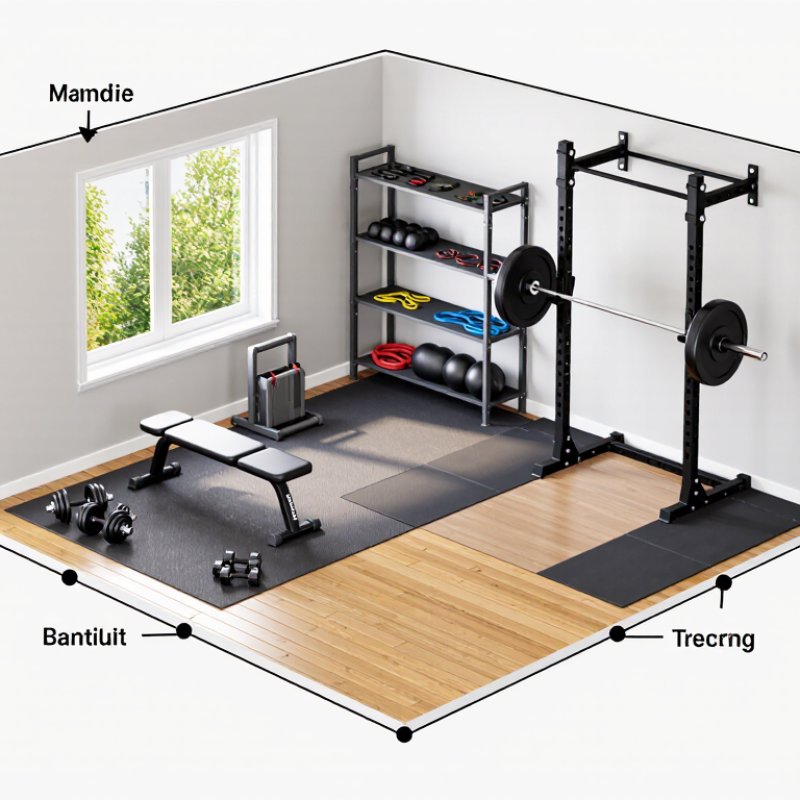
Measure the room before comparing equipment. Record usable floor length and width, ceiling height, door swings, outlets, and the route from the entrance. Then mark each item’s full footprint on the floor with painter’s tape. Include moving parts and the space needed to step on, adjust, or safely use it. A bench that fits neatly against a wall may still block a closet when extended. Small detail, big annoyance.
The U.S. Census Bureau’s 2023 Characteristics of New Housing report lists the median floor area of new single-family homes as 2,286 square feet. That figure is useful context, not a guide to gym space: room layouts and usable corners vary widely. Compare equipment dimensions with your actual clear floor area, not the home’s total square footage. Leave a walking path, and check ceiling clearance for overhead movements. Also measure doorways and turns; equipment that fits the room may not fit through the hall. A sketch helps, but it can miss awkward angles.
Tips: Use tape to outline each footprint, then rehearse the exercise motion in that space. Keep a little extra room where possible. I’d recheck after placing mats; they can shift the usable area more than expected.
How to Choose the Best Home Gym Equipment?
Measure Available Space and Check Each Equipment Item’s Footprint
Approximate floor space varies by model and setup. Measure your available area and check each item’s dimensions before buying; also allow room to use the equipment safely.
Match Cardio Equipment to the CDC Target of 150 Weekly Moderate-Intensity Minutes
For most adults, the CDC recommends at least 150 minutes of moderate-intensity aerobic activity each week. That can mean five 30-minute sessions, or shorter bouts spread across the week. Choose equipment that makes those minutes realistic: a stationary bike may suit someone who prefers seated, lower-impact movement, while a treadmill allows walking at a controlled pace. No machine is automatically the best choice.
Use the talk test to judge effort. At a moderate pace, you should be able to talk, but not sing comfortably. Start with a setting you can sustain, then adjust resistance or speed as your fitness improves. A session might be a brisk walk while the kettle cools, or steady cycling beside an open window. Small details matter: available floor space, noise, and whether the equipment feels comfortable after ten minutes. It is easy to buy for an imagined routine. Be honest about yours. If you miss a session, note why and revise the plan rather than treating the weekly target as all-or-nothing.
How to Choose the Best Home Gym Equipment? — Match Cardio Equipment to the CDC Target of 150 Weekly Moderate-Intensity Minutes
| Equipment Type |
Typical Moderate-Intensity Activity |
Example Weekly Plan |
Weekly Minutes |
Progress Toward 150-Minute Target |
Approximate Floor Space |
Impact and Practical Considerations |
| Treadmill |
Brisk walking at a pace that raises breathing and heart rate while still allowing conversation |
30 minutes per session, 5 days per week |
150 |
100% — meets the weekly target |
About 3 × 6 ft (0.9 × 1.8 m); check the product’s full operating and clearance requirements |
Weight-bearing exercise; walking is generally lower impact than running. A handrail and adjustable incline may help with comfort and progression. |
| Stationary Bike |
Steady pedaling at a moderate effort; adjust resistance so the pace feels purposeful but sustainable |
30 minutes per session, 5 days per week |
150 |
100% — meets the weekly target |
About 2 × 4 ft (0.6 × 1.2 m); allow extra room to mount and dismount |
Low-impact option. Seat height and position should be adjusted for a comfortable pedal stroke; recumbent designs may provide back support. |
| Elliptical Trainer |
Continuous movement at a moderate pace with enough resistance to maintain a steady effort |
30 minutes per session, 5 days per week |
150 |
100% — meets the weekly target |
About 2.5 × 6 ft (0.8 × 1.8 m); confirm ceiling height and stride clearance |
Typically low-impact because the feet remain on the pedals. Moving handles can involve the upper body, but the workout should still feel moderate. |
| Indoor Rowing Machine |
Steady rowing with controlled strokes and consistent effort; keep technique comfortable throughout the session |
25 minutes per session, 6 days per week |
150 |
100% — meets the weekly target |
About 2 × 8 ft (0.6 × 2.4 m) when in use; some models fold for storage |
Uses both upper- and lower-body muscles. Proper technique matters; beginners may prefer shorter sessions while learning the movement. |
| Any combination of cardio equipment |
Count time spent at moderate intensity across different activities |
For example: 20 minutes of brisk walking on 3 days and 30 minutes of cycling on 3 days |
150 |
100% — meets the weekly target |
Depends on the equipment selected |
Mixing activities can add variety. Moderate intensity is commonly described as being able to talk but not sing; individual effort varies. |
Planning note: The CDC recommends at least 150 minutes of moderate-intensity aerobic activity per week for adults. Activity can be divided across the week, and shorter periods can count toward the total. Space figures are approximate examples, not universal equipment specifications; check the dimensions and safety-clearance guidance for any unit. If you have a health condition or are unsure how to begin, consult a health professional.
Compare Resistance Options for Progressive Overload and Versatile Training
A useful home gym makes it easy to add resistance gradually, not just collect equipment. Dumbbells offer clear, measurable increases in load and work well for presses, rows, and squats. Adjustable models save floor space, though changing plates between exercises can interrupt a workout. That can get annoying.
Resistance bands are inexpensive, portable, and useful for warm-ups or lighter accessory work. Their tension increases as they stretch, so resistance is harder to measure precisely. A band that feels manageable near your feet may pull strongly near your shoulders. Check it for cracks before training, and anchor it securely.
For versatile training, compare how each option supports your actual routine. A compact cable system can provide steady resistance from several angles, while a bench and dumbbells allow many movements with little setup. Bodyweight exercises need no extra load, but eventually some may become too easy. Keep a simple log of repetitions, resistance, and form. When you can complete all your planned repetitions cleanly, increase the load slightly or choose a harder variation. Progress does not need to be dramatic. A small, repeatable increase is often more useful than buying equipment you rarely use. One imperfect but practical choice is a pair of adjustable dumbbells; they cover many exercises, but they may not suit every budget or space.
Assess Smart Features Against ACSM’s 2024 Top Fitness Trend: Wearable Technology
ACSM’s 2024 Worldwide Fitness Trends survey ranked wearable technology as the year’s leading fitness trend. That ranking signals strong professional interest, not proof that every smart machine improves results. When choosing home gym equipment, check whether its data can pair with a wearable you already use. A clear heart-rate display and reliable workout history may matter more than a touchscreen packed with extras.
Accuracy deserves attention. A 2017 Stanford-led study, published in the Journal of Personalized Medicine, tested seven wrist-worn devices with 60 volunteers. Their heart-rate readings had average error below 5%, while energy-expenditure estimates averaged 27% error. Treat calorie counts as rough estimates, not precise measurements. Small differences in sensor placement, movement, and fit can change readings.
Picture a short strength session beside a treadmill: a wearable might track pulse, while the equipment records speed and duration. Useful. But check that the numbers are easy to review, and ask whether the system still works without a paid connection. A simple bike with stable resistance may suit your routine better than a feature-heavy model. It is easy to overvalue dashboards. That judgment can be wrong. Pick features you will actually use, and leave room to reassess after a few weeks.
Conclusion
Choosing the right Home Gym Equipment starts with defining what you want to achieve. Build your plan around two strength-training days per week, then consider which activities and equipment will help you stay consistent. Before buying anything, measure your available space and check each item’s footprint, including the room needed to use it safely and comfortably.
For cardio, choose equipment that suits your preferences and can help you work toward the CDC target of 150 minutes of moderate-intensity activity each week. Compare resistance options by how easily they support progressive overload, exercise variety, and different fitness levels. Finally, decide whether smart features are useful for tracking progress and supporting motivation, in line with the growing interest in wearable technology highlighted by ACSM’s 2024 fitness trends. A thoughtful balance of goals, space, versatility, and useful tracking can make a home setup practical and sustainable.